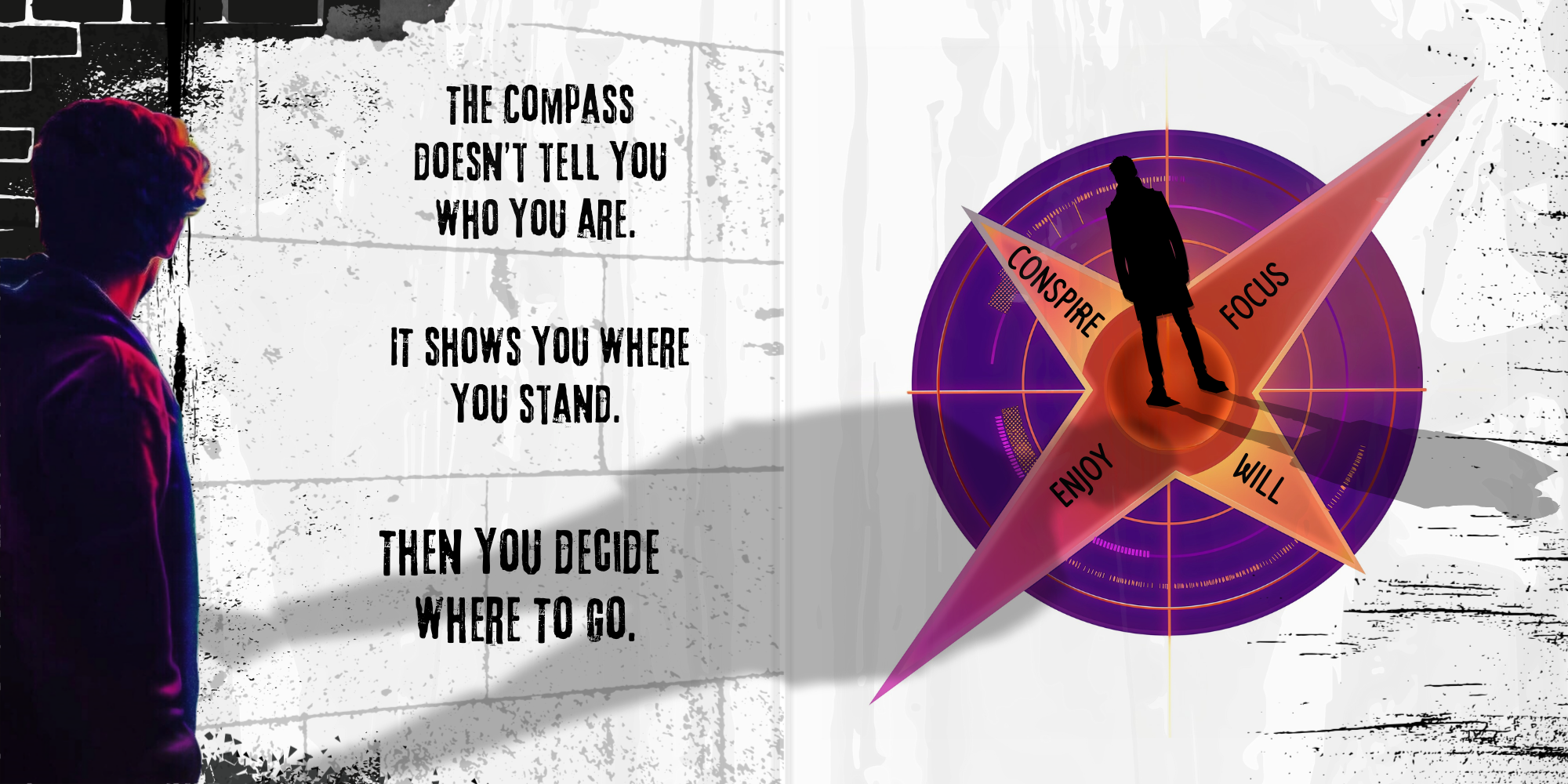
Stuck in a Thesaurus of Blame, When What You Need Is Action
Stuck. Blocked. Stalled. Paralyzed. Lost. We have dozens of words for inaction and none that tell you what to do about it. Here are 5 that actually do.

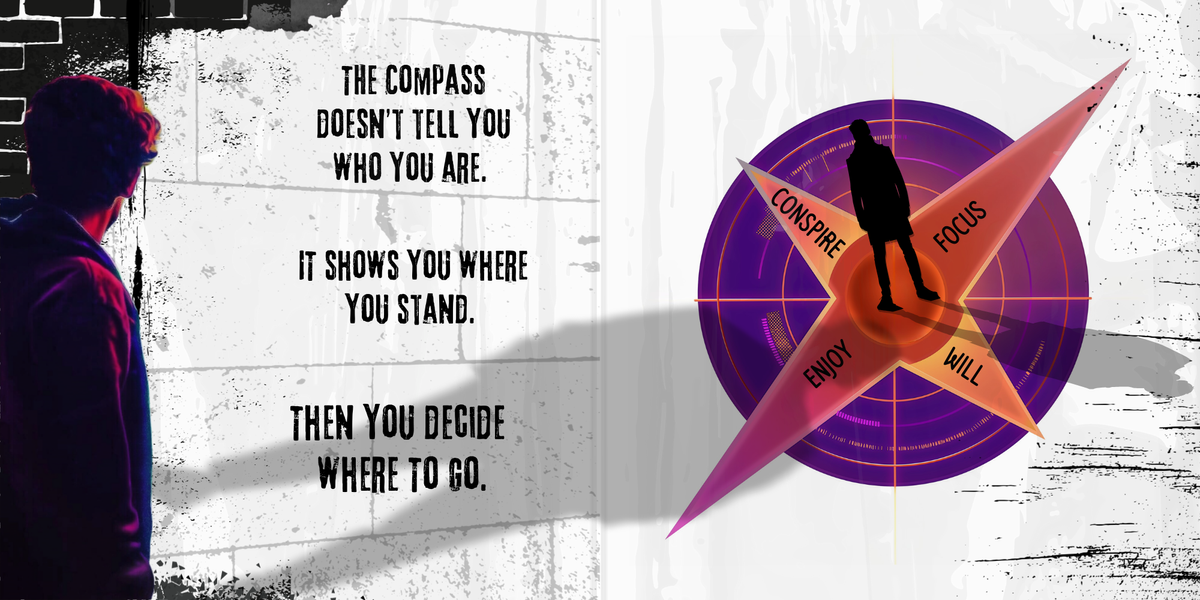
Stuck. Blocked. Stalled. Paralyzed. Lost.
Five words. All lazy. All useless. Every one of them describes a symptom and mistakes it for a diagnosis — like saying "it hurts" and expecting the doctor to know you actually have a broken heart.
And those are just the polite ones. We've got an entire thesaurus of ways to say the same nothing: Swamped. Buried. Drowning. Crushed. Stretched thin. Maxed out. Running on fumes. Underwater. White-knuckling it. Hanging by a thread. Pulled in every direction. Suffocating. Gasping. Sinking.
We have dozens of words for feeling overwhelmed and not a single one that tells you what to do about it. Worse — they glorify inaction. "I'm drowning" sounds heroic. "I'm swamped" sounds important. "I'm stretched thin" sounds like a martyr worth admiring. These words don't just describe your situation — they justify it. They let you be the victim of your own story when what you need is to be the hero.
Anchors, Not Arrows
Every one of these words pins you to where you are instead of pointing you toward where you need to go. We've built an entire vocabulary for justifying inaction and none for diagnosing it.
Here are 5 words that make you the hero instead of the victim: Focus. Will. Enjoyment. Conspire. Meaning.
Five bearings of completion. Each one is a direction you can move in. And each one has a dark side — a specific flavor of inaction that shows up when that bearing breaks down: Drift, Freeze, Drain, Isolation, Hollow.
The Wrong Instrument, Not the Wrong Volume
Think of it like five instruments in a band. When they're all playing, it sounds like music. When one drops out, it doesn't go silent — it goes wrong. And which instrument is missing creates a specific kind of wrong.
Most advice treats completion like a volume knob. Just turn it up. Try harder. Want it more. Grind. That's bullshit. It's not about volume. It's about which instrument is broken. And I've spent years figuring this out — not from a therapist's chair, but from the wreckage of my own half-built projects and from watching a million users on a platform I built do exactly the same thing.
Here's the map. Five bearings. Five ways they break.
Flavor 1: Drift — When Focus Breaks Down
You're not lazy. You're a pinball. Drift is what happens when the Focus bearing collapses. You have energy — God, you have energy — but it's spraying in seventeen directions like a garden hose with no one holding it.
Drift is the most deceptive flavor because it feels like productivity. You're always doing something. You've got tabs open, projects in flight, conversations spinning. From the outside you look like a hummingbird. From the inside you know the truth: you're a shopping cart with a wonky wheel, moving fast and pulling left.
I know this one personally. I've built four companies. I also have a graveyard of ideas I started and abandoned — not because they were bad, but because the next idea showed up wearing a nicer outfit. Drift doesn't lack fuel. It lacks a rudder.
Diagnostic questions:
- Do you have more active projects than you can count on one hand?
- When someone asks "what are you working on?" do you stall because there's too much to pick from?
- Do you end days feeling exhausted but can't point to one thing that actually moved the needle?
If you're nodding, stop looking for motivation. You need a target. One target. The courage to let the other sixteen starve.
Flavor 2: Freeze — When Will Breaks Down
You can see the door. You have the key. Your feet are bolted to the floor. Freeze is the collapse of Will — your capacity to act when acting is hard, uncomfortable, or terrifying.
Everyone thinks they understand Freeze because everyone calls it procrastination. But procrastination is the weather report. Freeze is the atmospheric pressure underneath. Your nervous system has decided this task is a saber-toothed tiger, and it's locked the controls. You can scream at yourself all day. The lizard brain has the keys and it's not giving them back.
Freeze is the person who opens the document, reads the same paragraph three times, then "just quickly checks" email for forty-five minutes. It's the gym bag packed by the door for three weeks — a little monument to good intentions and locked joints. It's rehearsing the conversation you'll never actually have.
Diagnostic questions:
- Is there one specific thing you've been avoiding for more than two weeks?
- Do you feel it in your body — tightness, dread, a fog that descends the moment you sit down to do the thing?
- Can you describe exactly what needs doing, step by step, and still not do it?
If that's you, the problem isn't clarity. It's activation. Your starter motor is jammed. No amount of GPS coordinates will help a car that won't turn over.
Flavor 3: Drain — When Enjoyment Breaks Down
You're winning. And it's hollowing you out like a rotten tree. Drain is the sneakiest flavor because it wears the costume of success. You're completing tasks. Hitting milestones. Your LinkedIn looks fantastic. And every box you check costs more than the last.
When the Enjoyment bearing goes, you lose the renewable fuel. You're running on diesel fumes and duty. This is the person grinding through a career they chose when they were basically a fetus, finishing a degree that stopped mattering two years ago, maintaining a project that quietly became a prison while they were busy calling it a passion.
Here's what makes Drain dangerous: nobody stages an intervention for someone who's producing results. Your friends think you're killing it. Your boss thinks you're killing it. You are killing it — the "it" just happens to be yourself.
Diagnostic questions:
- Are you finishing things but feeling emptier afterward, not fuller?
- Has something you once loved become something you endure — like a song that's been stuck on repeat so long you'd rather hear silence?
- If nobody was watching or expecting anything, would you still be doing this? Honestly?
If Drain is your flavor, pushing harder is exactly wrong. The question isn't "how do I do more?" It's "what would I actually choose if the scoreboard went dark?"
Flavor 4: Isolation — When Conspire Breaks Down
You're trying to play a team sport in an empty stadium. Conspire — from the Latin "to breathe together" — is the bearing of collaborative completion. When it fails, you're not stuck because you lack direction, discipline, or desire. You're stuck because the thing you're building needs other humans and you've convinced yourself it doesn't.
Isolation is the entrepreneur who won't ask for help because asking means admitting they don't have it figured out. The writer sitting on a draft they won't show anyone because it's "not ready." (It's been "not ready" for eight months.) The leader who hoards tasks because delegation feels like losing control — like handing your guitar to someone who might play the wrong chord.
And it compounds. That's the cruel part. The longer you go solo, the harder it gets to reach out, because now there's a thick crust of shame on top. I should have sorted this by now. If I ask for help now they'll know I've been floundering.
Diagnostic questions:
- When did you last ask someone — anyone — for help with this specific thing?
- Are you protecting a project from feedback because it's "not ready," or because you're not ready to hear what they'll say?
- Does asking for support feel like admitting defeat?
If this one hits, the block isn't inside you. It's the wall you've built between you and the people who'd actually make this possible.
Flavor 5: Hollow — When Meaning Breaks Down
You could finish. You just can't remember why you'd bother. Hollow is the existential flavor. The Meaning bearing is what connects what you're doing to who you are — your values, your identity, the dent you want to leave. When it collapses, the task doesn't get hard. It gets irrelevant. Like reading a book in a language you used to speak.
Hollow often shows up after a win. You climbed the mountain. Planted the flag. Looked around and thought, "Is that it?" Now you're supposed to climb another one and the whole premise feels like a con. Not burned out — that's Drain. Just... untethered. The engine is running fine. It's just not connected to the wheels.
This is the flavor that scares people the most, because it raises the uncomfortable question: what if the problem isn't how I'm doing things, but what I chose to do?
Diagnostic questions:
- If you finished this tomorrow, would it change anything that actually matters to you?
- Can you name a specific person — including yourself — who genuinely benefits from this being complete?
- Does this work connect to something you'd want in your eulogy, or just your résumé?
If Hollow is your flavor, you don't need a system, a coach, or a better morning routine. You need a reason. And finding one might mean burning down something you've already built. Which is terrifying. And sometimes exactly right.
Wrong Prescription, Wrong Patient
Here's the damage loop: you misdiagnose your flavor, you grab the wrong tool, it doesn't work, and you conclude that you are the problem. You're not. The prescription was wrong.
Give a person in Drift an accountability partner — a Conspire fix — and you've just hired a witness to watch them scatter. Hand a person in Hollow a productivity system — a Focus fix — and they'll beautifully organize their meaninglessness into color-coded categories. Tell a person in Freeze to "find their joy" — an Enjoyment fix — and they'll feel like a failure for not enjoying something they can't even start.
The remedy must match the flavor. That's the whole game.
And here's the nuance people miss: your dominant flavor shifts. It changes across projects, across seasons, sometimes across the same damn week. You might be Drift on your business and Freeze on your health and Hollow on the novel you keep telling people you're writing. This isn't a personality type. It's a diagnostic lens. Use it per situation, not as a tattoo.
Name It to Fix It
The diagnostic questions above will get you started. If you want the full picture — all five bearings measured, your completion archetype mapped, and the specific Rogues that are sabotaging you identified — take the free quiz at quiz.endregret.com. Five minutes. No fluff.
Because you already know you're stuck. That was never the mystery. How you're stuck — that's the part that sets you free.
FAQ
What's the difference between procrastination and the 5 flavors of inaction? Procrastination is the symptom, not the disease. It shows up across multiple flavors — Drift procrastinates by task-switching, Freeze procrastinates by avoidance, Drain procrastinates by doing easier work instead. The 5 flavors identify the root system underneath the procrastination so you can treat the cause, not just curse the effect.
Can you have more than one flavor of inaction at the same time? Absolutely. Most people have a dominant flavor and a sidekick. They shift depending on the project, the season, or what just blew up in your life. But in any specific moment of stuckness, one flavor is usually running the show. Find that one first — addressing it often loosens the others.
How is this different from personality typing like Myers-Briggs or Enneagram? Those describe who you are. The 5 flavors describe what's blocking you right now. They're situational and changeable. You might be Drift on Tuesday and Freeze on Friday. The goal isn't to put yourself in a box — it's to figure out which wall you're hitting so you can go around it.
What should I do once I know my flavor? First thing: stop the wrong treatment. If you're in Hollow, put down the planner. If you're in Isolation, stop white-knuckling it alone. Each flavor has corresponding strategies, and the completion quiz maps your specific pattern across all five bearings with targeted next steps.
Is "inaction" always bad? Sometimes I need to rest. Choosing to pause is a decision — that's not inaction. Inaction is when you want to move and can't, or you're moving but nothing meaningful is changing. Rest is a feature. Inaction is a bug. The five flavors help you tell the difference so you stop beating yourself up for healthy pauses and start addressing the unhealthy stalls.
Where does the Five Bearings framework come from? The Five Bearings — Focus, Will, Enjoyment, Conspire, and Meaning — are part of the End of Regret completion psychology framework, developed from years of studying why people start things and don't finish them. They form the diagnostic core of the completion archetype quiz.
SR;MR (Slow Read; Must Reflect)
- Inaction isn't one thing — it's five distinct flavors, each from a different broken bearing
- Drift (Focus): you're a pinball, not a person with a plan — need aim, not energy
- Freeze (Will): your starter motor is jammed — it's neurological, not moral failure
- Drain (Enjoyment): winning while losing yourself — success wearing a costume
- Isolation (Conspire): solo-ing a team sport — the lone genius myth will eat you alive
- Hollow (Meaning): the engine runs fine but it's not connected to the wheels
- Wrong diagnosis → wrong intervention → you blame yourself. Stop that loop.
Your flavor shifts across projects and seasons — diagnose the situation, not your identity